List of Works, Links, and Timings
Program Notes
1. Rock Art in the Dreamworld (2007)
Scored for: Native American Flutes (high and low E played by single performer) with soundscape (or duet version with Digeridoo in E) | Duration: ~8:00
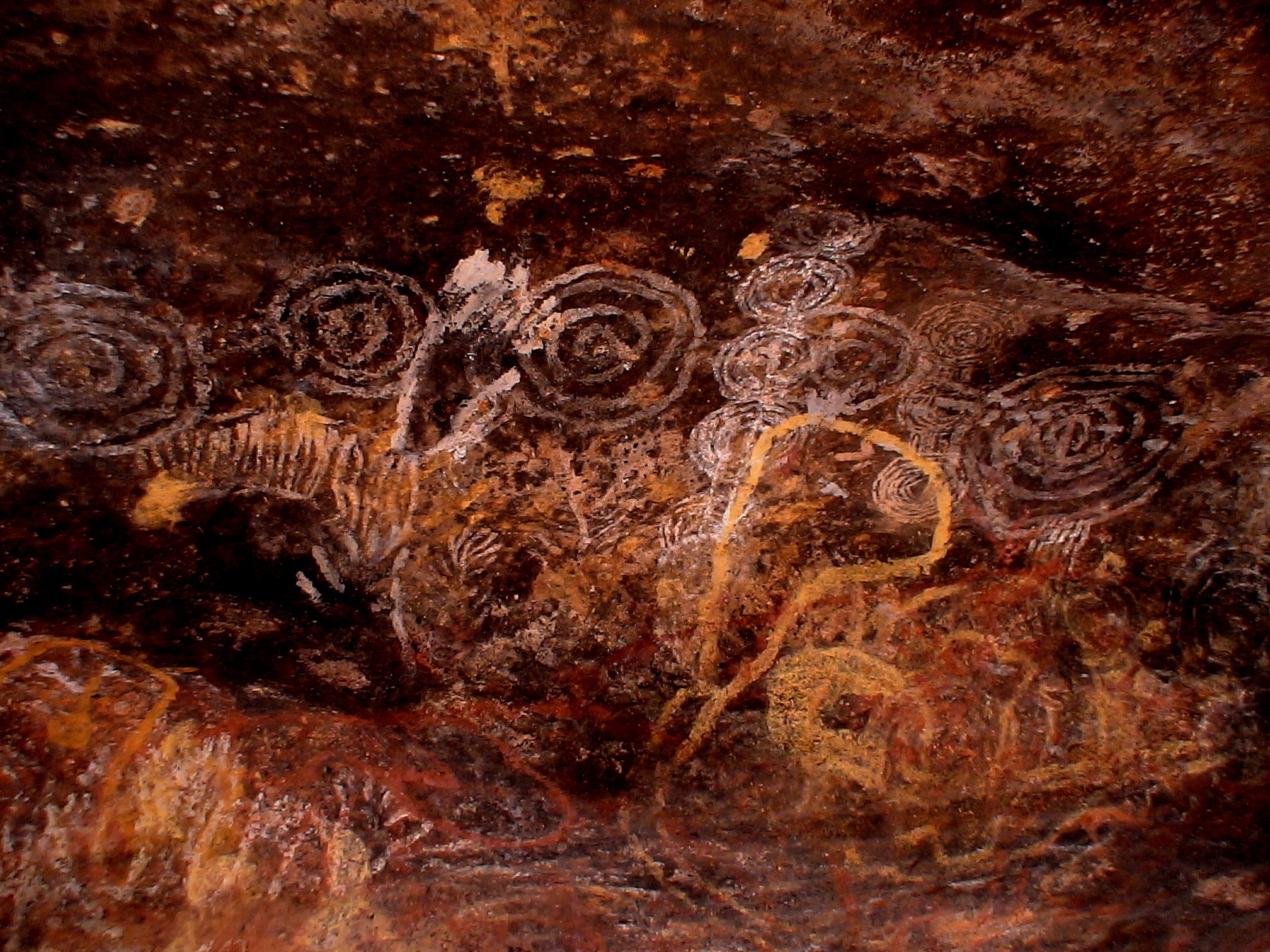
Rock Art in the Dream World is inspired by Hawaiian petroglyphs, and native American and Australian rock paintings.
The characters depicted in the rock art, such as Kokopeli in the American Southwest, and Namarrgon (the Lightning Man) and
Kuringali (the Rainbow Serpent) in Kakadu in Australia, have traditional stories, which belong to the peoples who created them.
Lydia was inspired as much by the idea of the ancient peoples who left their stories behind on stone as she was by my encounter with thartwork itself. From the “Dreamways” of the Iroquois to the
“Dreamtime” or “Dreaming” of the indigenous Australians, these stories have been described as dream worlds.
In Rock Art in the Dream World, Lydia has created her own story. The characters are the people who traveled through their natural world and their dreams to create the rock art. In this story, the native
American flute and the didgeridoo represent two human characters. Accompanied by their synthesized dream selves, they stroll through a natural environment of birds and crickets. The rock
tap rhythm seems to dance as they create the art. In a solo, the didgeridoo (accompanied by its dream self) contemplates the art, and together the flute and didgeridoo add finishing touches. The
thunderous flapping of a large flock of small green parrots opens the gate into the dream world. The rock rhythm stops, time slows down. In the dream memory, the bird songs are stretched out, the
cricket chirps become long tones, the footsteps and rock taps are backward. Are the characters trapped in the dream? The flute begins to call the sentinel bird, but, where is it? At last, the bird
responds and the green parrots open the gate to return to the natural world. The return is a memory of all the experiences of the natural world, making the rock art and the dream world, at a quick pace
as the pressure of time returns. Must we return by sunset or reach a meeting point by a particular time? Kangaroos hiss at us as we complete our journey.
Thanks to David Hudson and Ash Dargan, whose recordings were used (with their permission) to analyze and synthesize the
dream didgeridoo using timbre morphing in Csound, and whose playing inspired this piece. High Spirits made the native American
flutes and Jim Akins made the turtle medicine rattle used in the piece. Lydia recorded the footsteps, crickets, kangaroos, kookaburra and other
birds in the Uluru, Kata Tjuta, Watarrka and Namadgi parks in Australia, and then synthesized the crickets and most of the birds using
an additive synthesis design. The only sampled bird is the kookaburra laughing in the natural world, and the synthesized kookaburra in the dream world uses a timbre
morphing design based on the didgeridoo design.
2. Temple of the Dancing Cascade) (1982/2010)
Scored for: Soundscape of Synthesized Instruments/Chamber Orchestra/Small Ensemble | Duration: ~10:20
Inspired by the beautiful landscapes of Zion, Bryce and Yosemite national parks in the southwest United
States, Temple of the Dancing Cascade is a story of four spirits representing a waterfall, fire, wind and
destruction. At the time that Lydia wrote it, she was fascinated with Middle Eastern music, and the piece uses
a Middle Eastern scale and characteristic asymmetrical rhythms transformed into her own style.
Scene 1 is In the Temple. The percussion instruments set the atmosphere in a serene, mystical, quasi
gamelan style. The strings and winds interlock in melodic fragments that suggest the light and dark
sparkling on the water in a stream. A descending rivulet of sound intertwines the woodwinds, and the
stream continues. In Scene 2, the timpani, tambourine and castanets set up a fast 9/8 beat (2 + 2 + 2 +
3) for the entrance of The Fire Spirit, who performs a wild dance. Brass fanfares punctuate the music
as the winds and strings continue interlocking melodic fragments. In Scene 3, The Wind Spirit swirls
around in a slower pas de deux with the fire spirit. With his diabolical laugh (in the muted trombone)
followed by ominous chords, The Demon of Destruction interrupts their tranquility. Scene 4 is the fight
to the death in disrupted meters, melodic fragments and fanfares. The piece ends with a death scream
from the descending woodwind stream, followed by anguished chords and a final, maniacal laugh.
3. Ombres des Feuilles (Shadows of the Leaves) (2012)
Scored for: Soundscape of Synthesized Instruments | Duration: ~2:00
A whimsical encore piece to Temple of the Dancing Cascade.
4. Appetizer and Pendopos (1995 and 2000)
Scored for: Soundscape | Duration: ~5:40
The Appetizer section is algorithmically composed in slendro using virtual flute and Woodstock gamelan.
Pendopos is a playful romp in just intonation using Woodstock gamelan, Risset songs, and birds recorded
in Bali.
5. Ghost Winds Talking (2007)
Scored for: Soundscape | Duration: ~5:00
Ghost Winds Talking is based on the melodious wind whistling across the edge of the bathroom window
like a giant flute, and synthesized ghost voices of Harry Partch, Nadia Boulanger, Aaron Copland,
and Lou Harrison.
6. Ombres de la Lune (Shadows of the Moon) (1977/1998)
Scored for: Soundscape | Duration: ~9:30
A mysterious piece, originally scored for the Helix Song, a microtonal percussion instrument
invented by Erv Wilson. This version is realized on the synthesized Woodstock gamelan.
7. Lips of Stone (2008)
Scored for: Chinese Xun and Video Soundscape | Duration: ~2:50
In the wild days of my youth, I took many photos during camping trips in the American southwest, including Bryce Canyon in Utah. When I returned
home, the suggestive shapes of the scenery inspired my imagination to write a poem. Lips of Stone is a setting of that poem for live xun, video and
computer music soundscape. The xun is a Chinese vessel flute which is usually made from clay, but I also have a stone xun which I wanted to use for
this piece. Sometimes, when I blow across the xun’s stone lips for too long, my lips feel like stone, too.
Context affects how we perceive something. For example, we all know the story of the birds and the bees.… The honeybee is the state insect of Utah,
and there is a little buzz or two in the soundscape, but I’m personally fonder of birds. I found a number of Utah birds on Cornell Laboratory of
Ornithology’s Birds of the Southwest Rio Grande Valley. And what a wondrously noisy set they are, too!
Interesting how close bird sounds can come to human sounds…. You’ve heard of “cooing like a dove?” Hope you find it a real “hoot.”
Ice storms have etched
hidden canyons where your images
undulate in folds of stone
the leaves are layers of hair
which veil old wrinkles
in the skin of stone
finger of fire
your intense colors vibrate
in front of the sky
when you caress
the soft natural crevasses
in the lips of stone
haunting resonance
cry of silence
screams of stone
– Lydia Ayers
8. In the Throne Room of the Mountain Spirits (2007)
Scored for: Soundscape of Synthesized Instruments/Chinese Xun and soundscape/Chinese Orchestra | Duration: ~6:20
“In the Throne Room of the Mountain Spirits” is a movement from Journey to the Mountain
Spirits, which represents my personal “journey to the west.” West, of course, is relative, so for
me west is anywhere west of New York. The southwest of the United States contains particularly
beautiful landscapes. In the Native American traditions, these landscapes are full of “spirit”
which you can still sense if you spend some time in silence in the national canyon and mountain
parks, such as Bryce, Zion and the Grand Canyon. Hiking up these mountains, the clear view
appears between the sculptured rocks, and at the top, surrounded by the stone spirits, the view
opens up all around.
Now I live farther to the west, on the eastern edge of the Middle Kingdom. For me now the
“west” is western China, and the “east” is that magical place that used to be in the southwest.
As you listen to this music, imagine your journey taking you to your personal “west.”
9. Ombres de la Pluie et de la Neige (Shadows of the Rain and Snow) (1977)
Scored for: Piccolo/Alto Flute | Duration: ~5:10
A solo piece for piccolo and alto flute. The fast first section on piccolo is atonal and suggests the sporadic pattering
of the Rain. The slow second section on alto flute is modal and suggests the slow drifting of the flakes of Snow.
Jody Meese and Dennis Rihn played this performance.
10. Ansikten (Faces) (1976)
Scored for: Piccolo/Flute/Alto Flute/Bass Flute | Duration: ~9:50
Ansikten (Faces) is dedicated to Swedish flutist Georgia Mohammar, for whom it was composed and who played the premiere.
This piece uses the alto flute, bass flute, piccolo and C flute in turn in the four sections, which are inspired by short,
haiku-like poems about the four elements. The timbres of the flutes and the modal scales chosen for the sections suggest
those elements, and the high flute harmonics in the last section particularly suggest the ethereal quality of the air and
clouds.
Vatten (water) (alto flute)
She was an obsidian lake
frozen black mirror
holding the faces of trees
Eld (fire) (piccolo)
She was dark
as fast black flames
wild as knives of light
slicing the night
Jord (earth) (bass flute)
The metallic sun slips
through translucent lips of leaves
sheets of green cellophane
shivering like a tambourine
Luft (air) (C flute)
She glides high as clouds
and as free in shape
plucking the mouths of air with branches
on a harp
11. Great Spirit Song (2006)
Scored for: Treble Choir with optional Native American Flute (or Western Flute) and Soundscape | Duration: ~8:30
Great Spirit Song, for treble choir, Native American flute and recorded computer music soundscape, is an invocation to the
Great Spirit inspired by the culture of the Native American people. The choir sings a two-part adaptation of the text “Great
Life-Giving Spirit.” Interludes between the text sections include Yeibichai-inspired pow-wow chanting in interlocking antiphonal
rhythms. The pow-wow drum functions as the heartbeat of the piece. The recorded soundscape includes synthesized voices of
ghost ancestors and Native American flutes created with Csound along with sampled natural sounds, such as birds and wind.
On the video Songkeepers, Kevin Locke tells the origin story of the Native American flute: that as woodpecker ran back and forth,
opening and closing the holes in a hollow branch, the wind played it as a flute. Somewhat like a recorder in its design, the
Native American flute has a "fetish," often shaped as an animal, controlling the air flow.
The piece is in five parts using the traditional minor pentatonic scales come from the four Native American flutes.
Part 1 celebrates the North with Eskimo throat singing along with northern birds and animals such as wolves, whales and polar
bears. Part 2 celebrates the East, the direction of the sunrise. Part 3 celebrates the warm winds from the South, and features
a ceramic imitation of an eagle bone flute. Part 4 celebrates the sunset in the West, as the flute merges with the mournful cry
of the coyote. The soundscape also includes rattlesnakes and ghost horses against the afterglow of synthesized Native American
flutes in the background. As Part 5 celebrates the Earth and Sky, with eagles and fragments of the other sections, we may imagine
that we have entered the Native American dreamtime, where we can travel in several places at once without physical limitations.
Biographies
Lydia Ayers — Composer
Lydia Ayers (1952–2022) was a prolific composer, performer, and researcher based in Hong Kong, known for her pioneering work in microtonal tuning systems, extended wind techniques, and computer music synthesis. A master of traditional flutes from various global cultures, her acoustic portfolio includes over thirty solo and ensemble works for flutes, alongside an extensive catalog of electroacoustic compositions.
In 2006, Lydia Ayers was commissioned by the National Flute Association to write Time’s Graffiti: Lucky Calligraphy as the competition piece for the High School Soloist Competition. Her deep engagement with microtonality included extensive research into unlimited just intonation and the 75-tone Partch/Indian scale, which she implemented on her custom-built "Woodstock Gamelan" percussion instrument and modeled using Csound.
She co-authored the book and CD-ROM package Cooking with Csound: Woodwind and Brass Recipes with her husband, Andrew Horner, and released her solo album Virtual Gamelan (Albany Records) in 2006. Her flute and electronic works have been performed worldwide at major international festivals, including the Australasian Computer Music Conferences, the New West Electroacoustic Music Festival, the Sonoimagenes Festival in Buenos Aires, and the Musicarama Festival in Hong Kong.