More about HKUST


Revolutionizing Food Safety: CSE's Haiyan Hu Takes First Place in IEEE IoT PhD Thesis Competition
Dr. Haiyan Hu, a recent PhD graduate and current postdoctoral researcher at the Department of Computer Science and Engineering (CSE), has been awarded First Place in the prestigious IEEE IoT PhD Thesis Competition. Under the supervision of Prof. Qian Zhang, Dr. Hu's award-winning dissertation explores low-cost, portable spectral sensing, bringing advanced food and health analysis out of specialized labs and into everyday life.
Bringing Laboratory Science to Everyday Life
Conventional food analysis typically relies on expensive and bulky spectrometers, restricting routine monitoring to specialized laboratory settings. To bridge this gap, Dr. Hu's dissertation, "Smart Sensing for Food Nutrition and Safety: A Low-Cost, Portable Spectral Approach," combines near-infrared spectroscopy with consumer-grade electronics and machine learning. Through innovative hardware-software co-design, she has successfully developed a series of end-to-end, portable sensing systems.
These IoT systems have successfully executed critical applications, including calorie estimation, nutrition analysis, adulteration detection, and food quality assessment. Remarkably, Dr. Hu's research reduces sensing hardware costs from thousands of dollars to just $20–$100. Despite this drastic cost reduction, the technology maintains highly competitive performance, which was validated across extensive evaluations involving hundreds of food samples.
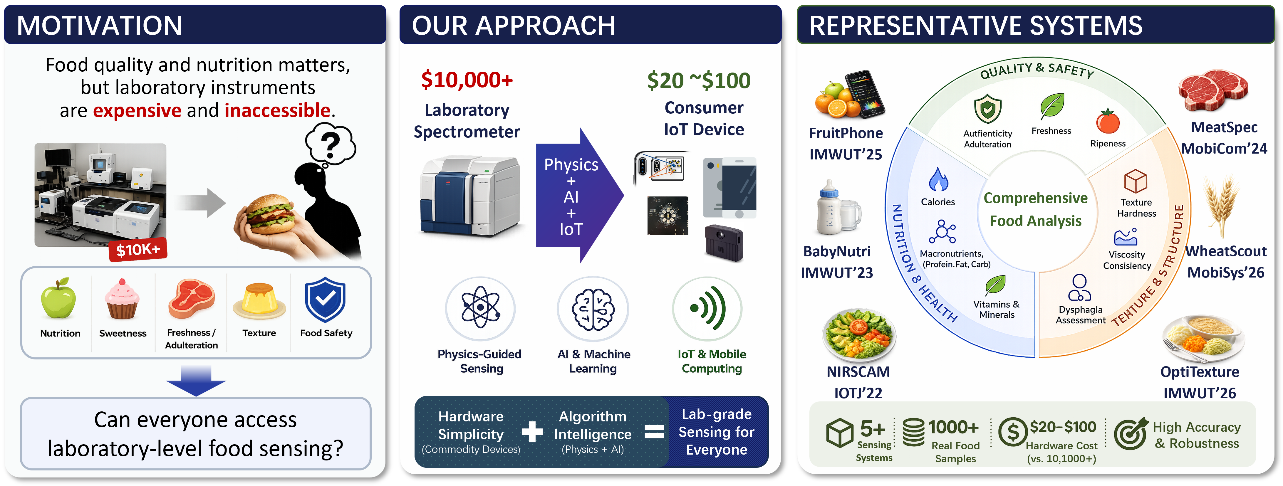
Overview of Haiyan Hu's research on ubiquitous computational spectroscopy.
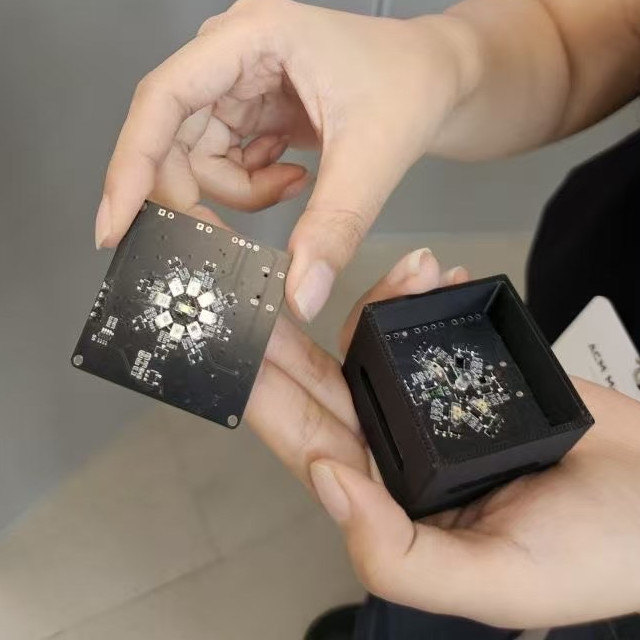
A low-cost spectral sensing prototype developed as part of Haiyan Hu's research.
A Broader Impact on Health and Wellness
Beyond food safety, Dr. Hu's research demonstrates how high-level analytical capabilities can be transformed into scalable IoT platforms with promising applications in healthcare and personalized wellness. Her groundbreaking work has already been published in top-tier venues such as ACM MobiCom, ACM IMWUT/UbiComp, and IEEE Transactions on Mobile Computing.
Reflecting on her achievement, Dr. Hu shared her vision for the future of her work. "I am truly honored to receive First Place in the IEEE IoT PhD Thesis Competition," she said. "This recognition means a great deal to me because it reflects not only my own PhD journey, but also the tremendous support and contributions of my supervisor, collaborators, and labmates. I hope our research can help bring advanced sensing technologies out of the laboratory and make them more affordable and accessible for real-world applications."
Dr. Hu also credited the strong academic community around her for this milestone. She expressed her sincere gratitude to Prof. Qian Zhang for her continuous guidance, as well as her collaborators, lab members, students, and family. Furthermore, she thanked the CSE Department and HKUST for providing an inspiring environment and abundant opportunities to explore interdisciplinary ideas.
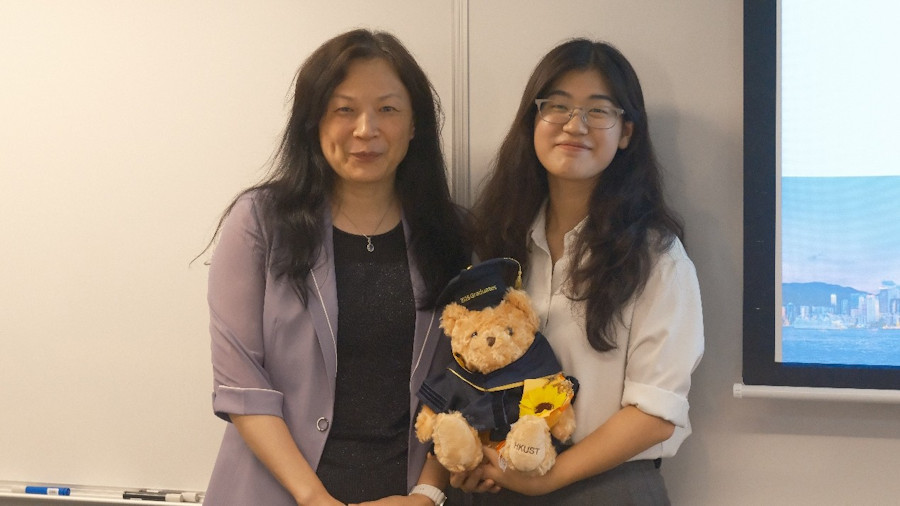
Haiyan Hu with her PhD supervisor, Prof. Qian Zhang, following her doctoral thesis defense at HKUST.
Next Steps
Dr. Hu continues to advance her research in mobile and IoT sensing as a postdoctoral researcher in Prof. Zhang's group at HKUST. Her success underscores the CSE department's commitment to fostering innovative research that addresses real-world challenges.
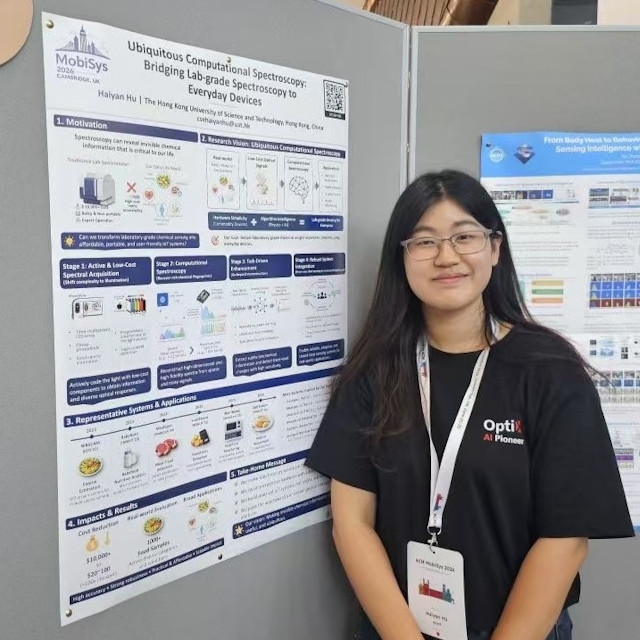
Haiyan Hu presenting her research on ubiquitous computational spectroscopy at the ACM MobiSys 2026 Rising Star Forum.
Navigation

Navigation


 Facebook
 LinkedIn
 Instagram
 YouTube
 Contact Us