More about HKUST


HKUST CSE Researchers Receive IEEE T-ASE Best Paper Award
A paper co-authored by Yu-Zhe Shi, Yanjia Li, and Prof. Huamin Qu from the Department of Computer Science and Engineering (CSE) at The Hong Kong University of Science and Technology (HKUST) has received the IEEE Transactions on Automation Science and Engineering (T-ASE) Best Paper Award. The paper is titled "Automated Constraint Specification for Job Scheduling by Regulating Generative Model with Domain-Specific Representation."
Established in 2004, the T-ASE Best Paper Award typically honors only one paper from more than 1,200 peer-reviewed articles published in the journal during the preceding calendar year. This marks the first time the award has been received by researchers from HKUST or any other institution in Hong Kong SAR.
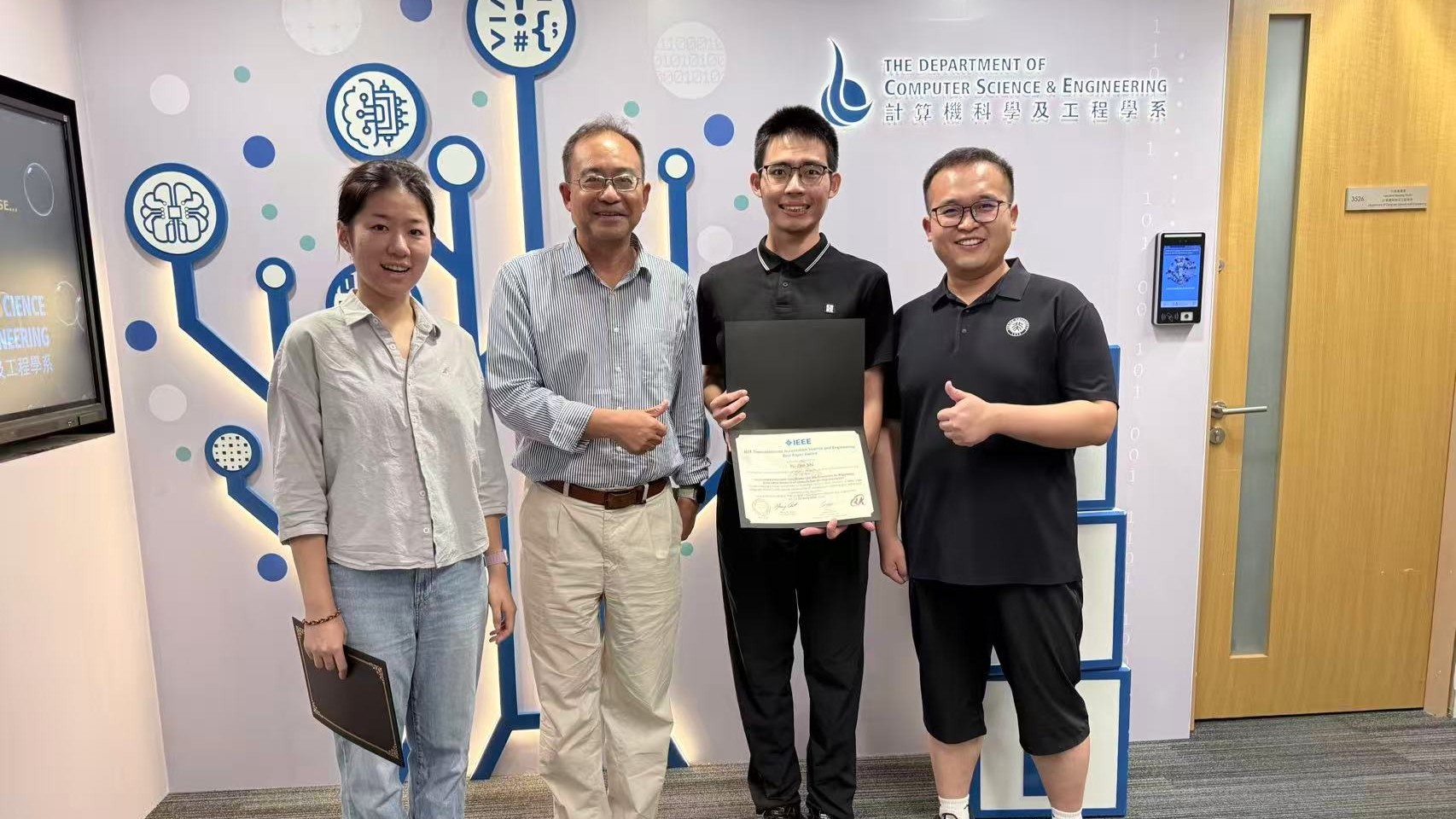
From left to right: Yanjia Li, Prof. Huamin Qu, Yu-Zhe Shi, and Prof. Lecheng Ruan, a collaborator from Peking University.
The study focuses on smart manufacturing scheduling driven by generative artificial intelligence (AI). It traces the mathematical abstractions of scheduling scenarios back to their source and addresses a key prerequisite: how to automatically transform heterogeneous and unstructured manufacturing data into reliable constraint specifications for job scheduling. Traditionally, this process has relied heavily on manual modeling by domain experts, posing major challenges in flexible manufacturing settings characterized by small-batch, high-variety production and creating a major barrier to digital transformation in real-world industrial settings.
The paper proposes a constraint-centric system architecture that regulates the generative behavior of large language models (LLMs) by defining a hierarchical domain-specific representation. It divides the complete workflow into three modules—constraint abstraction, constraint generation, and schedule grounding—enabling an end-to-end automated transformation from raw manufacturing documents, including natural-language process descriptions and semi-structured process route sheets, into formal scheduling constraints and ultimately executable production plans.
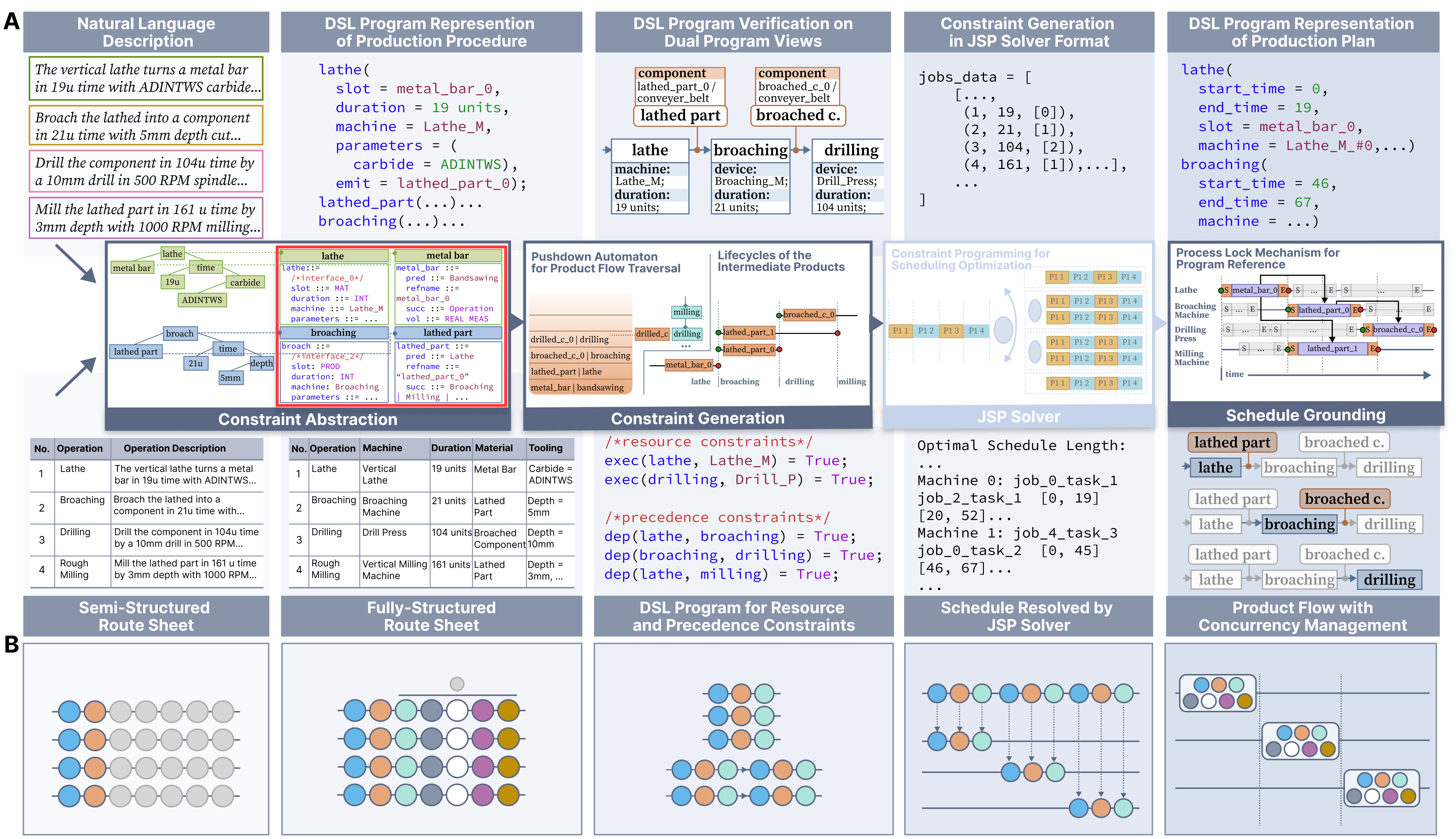
System architecture and end-to-end workflow for the automated generation of constraint specifications for job scheduling in smart manufacturing.
The core highlight of the work lies in integrating the powerful semantic understanding and generation capabilities of LLMs with the stringent precision and reliability requirements of manufacturing systems. Rather than simply assigning constraint generation directly to LLMs, the paper introduces domain-specific language program representations and a dual-view verification mechanism to structurally constrain the model's output space, effectively overcoming key challenges arising from natural-language ambiguity, nondeterministic model outputs, and gaps in domain knowledge.
At the same time, the proposed production scenario adaptation algorithm enables the architecture to efficiently adapt to the resource configurations and process requirements of different factories, allowing deployment without extensive human intervention. Experimental results show that the method significantly outperforms pure LLM-based approaches in constraint specification tasks, providing a highly instructive new paradigm for deploying generative AI in high-reliability industrial settings.
The work was in collaboration with the School of Advanced Manufacturing and Robotics at Peking University. It received funding from the National Natural Science Foundation of China and the Research Grants Council of Hong Kong, as well as support from the PKU-HEC Joint Lab for Industrial Intelligence.
Congratulations to Prof. Huamin Qu and the research team on this prestigious recognition!
Navigation

Navigation


 Facebook
 LinkedIn
 Instagram
 YouTube
 Contact Us