More about HKUST


Dr. Wei Wang and Students Received the USENIX NSDI 2026 Outstanding Paper Award
Dr. Wei Wang, Associate Professor in the Department of Computer Science and Engineering at HKUST, and his students have received the Outstanding Paper Award at the 23rd USENIX Symposium on Networked Systems Design and Implementation (NSDI 2026) for their paper, "Attack of the Bubbles: Straggler-Resilient Pipeline Parallelism for Large Model Training." The HKUST team includes co-first authors Tianyuan Wu and Lunxi Cao, as well as Hanfeng Lu, Xiaoxiao Jiang, and Dr. Yinghao Yu, a PhD graduate of Dr. Wang's research group. The work was conducted in close collaboration with researchers from Alibaba.
About the Award
USENIX NSDI is widely recognized as one of the most prestigious international conferences in computer systems and networking, bringing together leading researchers and practitioners to present advances in networked and distributed systems. The Outstanding Paper Award is one of the conference's highest distinctions. At NSDI 2026, only three papers received the award among 150 accepted papers. Notably, this marks the first time that an NSDI Outstanding Paper Award has been conferred on a university in Hong Kong, making the recognition a significant milestone for HKUST and the Hong Kong computer systems research community.
PipeMorph: A Resilient Training System
The award-winning work addresses an important challenge in training today's large language models (LLMs). Modern LLMs are often trained by distributing their workloads across tens of thousands of GPUs. At such a scale, even occasional delays in communication between machines can leave GPUs waiting for one another. These idle periods, known as "bubbles," can spread through the training pipeline and substantially slow down the entire process.
To tackle this problem, the team developed PipeMorph, a new training system that makes large-scale LLM training resilient to communication slowdowns. PipeMorph dynamically adjusts how computation is organized when delays occur and employs alternative data-transfer mechanisms to prevent slow communications from holding up subsequent computation. In this way, it prevents isolated communication delays from cascading into system-wide slowdowns. Experiments show that PipeMorph can reduce training iteration time by 1.2‐3.5× under communication stragglers, enabling more efficient use of costly GPU infrastructure and improving the robustness of large-scale AI training.
The work demonstrates how innovations in computer systems can address increasingly important infrastructure challenges arising from the rapid growth of AI, and highlights the value of close collaboration between academia and industry.
Congratulations to Dr. Wei Wang, Tianyuan Wu, Lunxi Cao, Hanfeng Lu, Xiaoxiao Jiang, Dr. Yinghao Yu, and all members of the research team on this prestigious achievement!
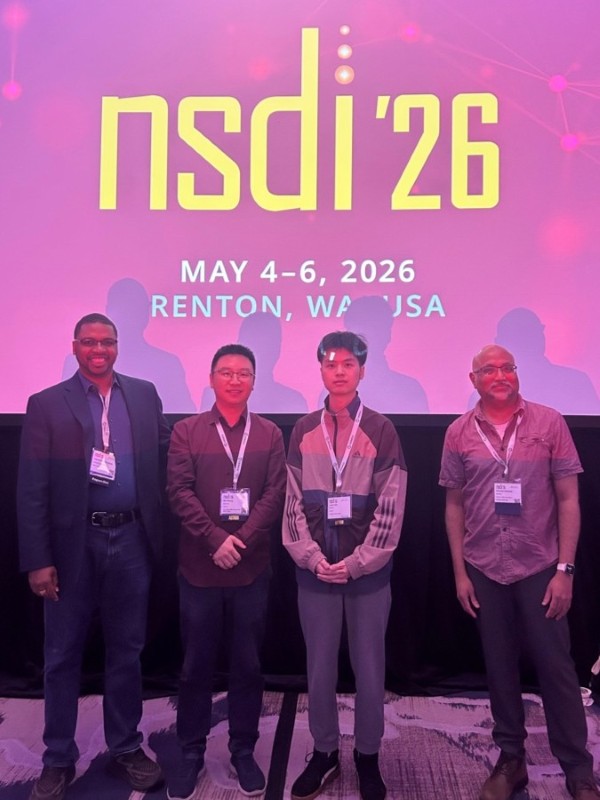
From left to right, Hakim Weatherspoon (Conference Program Co-Chair), Wei Wang, Lunxi Cao (co-first student author), Srikanth Kandula (Conference Program Co-Chair).
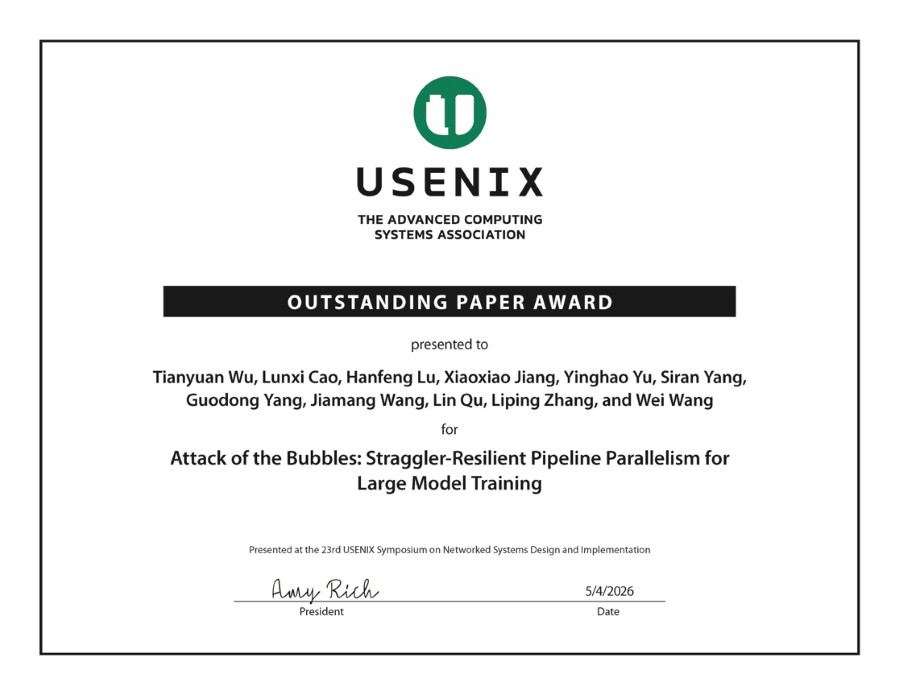
Certificate of the USENIX NSDI 2026 Outstanding Paper Award
Navigation

Navigation


 Facebook
 LinkedIn
 Instagram
 YouTube
 Contact Us